…but recently, I have been discovering new things about love & myself. Here’s a cocktail of things. What follows isn’t a conclusion. It’s more like a reckoning. A mix of what I believed, what cracked, and what I’m still learning to sit with.
One thing I have noticed is how love seems to soften men. We accommodate more. We become gentler, sometimes even self-effacing. Research does suggest that men’s testosterone tends to drop when they fall in love. With women, interestingly, it often rises in the early stages. They may become more confident, assertive, and outwardly directed.
I do not bring this up to make prescriptions, but because I find the shift fascinating.
It sometimes appears as though love rearranges our internal balance. Qualities we usually suppress quietly come forward. Men may touch tenderness more easily. Women may touch strength more openly. Not as roles, but as capacities.
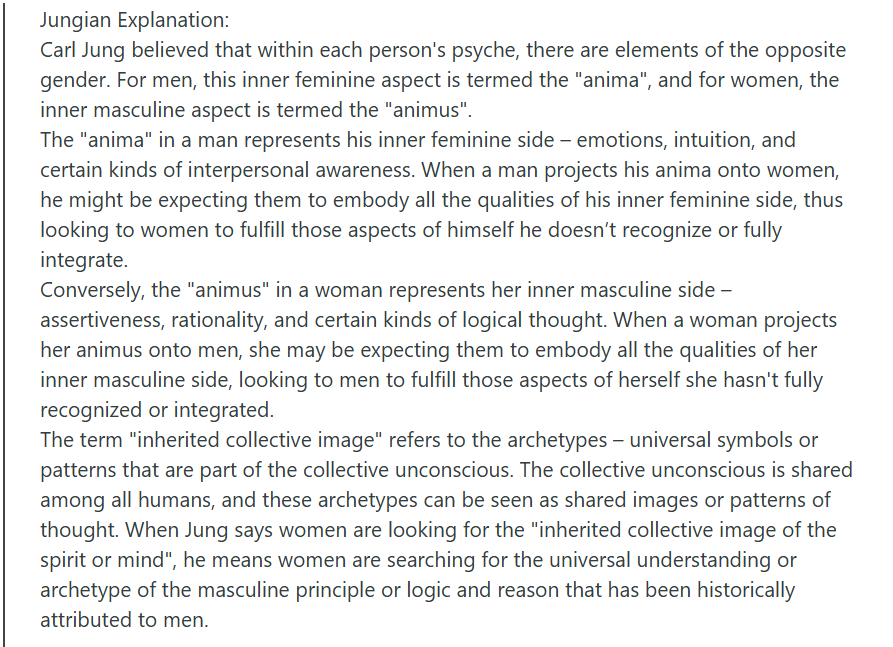
This led me to something Carl Jung explored deeply: the idea that each of us carries both feminine and masculine energies within us. He called them the anima and the animus. Not identities, but inner tendencies that often remain unconscious.
In love, these hidden parts seem to surface.
I began to notice that before choice ever enters the picture, something else often happens. Someone stands out. Quietly. Without effort. Not because they fit a checklist, but because they feel familiar in a way I cannot fully explain.
No amount of reasoning could undo that recognition.
I still believe deeply in choice. In standards. In walking away from what stops nourishing you. I do not think love excuses self-abandonment.
But I accept that there is something beyond our grasps. There is something inexplicable about it that cant be reasoned or intellectualized. That took me off on a tangent of discovery where Jung’s ideas began to resonate differently. He spoke of love as a meeting that happens at a level deeper than conscious intention, almost like recognition between inner worlds. A connection that does not begin with logic, but deepens when two people are willing to see both light and shadow in each other.
I am not certain how literally I take this. But experientially, it feels true.
I found a similar sense of relief in Osho’s words on love, though I hold them lightly. And even here, my belief in choice remains intact. If anything, understanding these ideas has not weakened my commitment to choice, but softened my rigidity around it. It has made me more willing to let love move through me, without needing to control every part of it.
Another idea that’s been quietly resonating with me lately is the paradox between wanting to control life and learning to let go. The strange truth that sometimes, the harder we try to make something happen, the more it slips away. Because it’s only when we stop trying to force things into place that they begin to unfold on their own.
Sometimes, our efforts to make something happen work against our own best interest.
In love, Alan Watts described this as a paradoxical act of surrender and risk, a ‘divine madness’ that requires letting go of control and embracing the unknown. I used to think you should “jump” into love, not “fall.” But now, I see it’s rightly a fall.
There is this dynamic between ‘unrequited love is bullshit’ and ‘real love is not a contract, it can exist without expectations’ – And I am in a place where I kind of, sort of, believe both. You cannot love truly with ‘ifs’ and ‘buts’ but you cannot also stay in something that stops nourishing you.
So I sit with the tension.
Perhaps love is neither pure choice nor pure surrender. Perhaps it is the uneasy space between the two. A place where discipline meets mystery. Where agency meets grace.
I no longer feel the need to resolve this.
Maybe love was never meant to be figured out.
Only noticed. Questioned. Lived.